- african
- albanez
- amharică
- arabic
- armean
- Azerbaidjan
- bască
- Belarus
- bengaleză
- Bosniac
- bulgară
- catalan
- Cebuano
- China
- China (Taiwan)
- corsicană
- croat
- ceh
- danez
- olandeză
- Engleză
- esperanto
- estonă
- finlandeză
- limba franceza
- frizonă
- Galician
- georgian
- limba germana
- greacă
- Gujarati
- creolul haitian
- hausa
- hawaian
- ebraică
- nu
- Miao
- maghiară
- islandez
- igbo
- indoneziană
- irlandez
- Italiană
- japonez
- javaneză
- Kannada
- kazah
- Khmer
- ruandez
- coreeană
- kurdă
- Kârgâz
- Muncă
- latin
- letonă
- lituanian
- luxemburghez
- macedonean
- Malgashi
- Malaeză
- Malayalam
- malteză
- maori
- marathi
- mongol
- Myanmar
- nepaleză
- norvegian
- norvegian
- occitană
- Pashto
- persană
- Lustrui
- portugheză
- punjabi
- Română
- Rusă
- samoană
- gaelic scoțian
- sârb
- Engleză
- Shona
- Sindhi
- Sinhala
- slovacă
- slovenă
- somalez
- Spaniolă
- Sundaneza
- Swahili
- suedez
- tagalog
- Tadjik
- tamil
- tătar
- Telugu
- thailandez
- turc
- turkmeni
- ucrainean
- Urdu
- Uighur
- uzbec
- vietnamez
- galeză
- Ajutor
- idiş
- Yoruba
- Zulu

feb. . 09, 2026 11:32 Înapoi la listă
Securing the Modern Jobsite: The Strategic Role of Temporary Chain Link Fencing
In the dynamic world of urban development and infrastructure repair, the perimeter of a construction project serves as the first line of defense against liability, theft, and public safety hazards. Choosing the right containment strategy is not merely a logistical checkbox; it is a foundational element of site management. Among the various options available to project managers today, temporary chain link fencing remains the industry standard for its unique balance of visibility, durability, and adaptability. Unlike permanent structures, these systems provide a robust barrier that can be reconfigured as a project evolves from excavation to final landscaping.
The effectiveness of a perimeter solution depends heavily on how well it integrates with the specific topography and security needs of a site. Whether it is a high-rise development in a congested city center or a sprawling highway expansion, the choice of materials dictates not only the safety of the public but also the efficiency of the crew operating within the bounds.
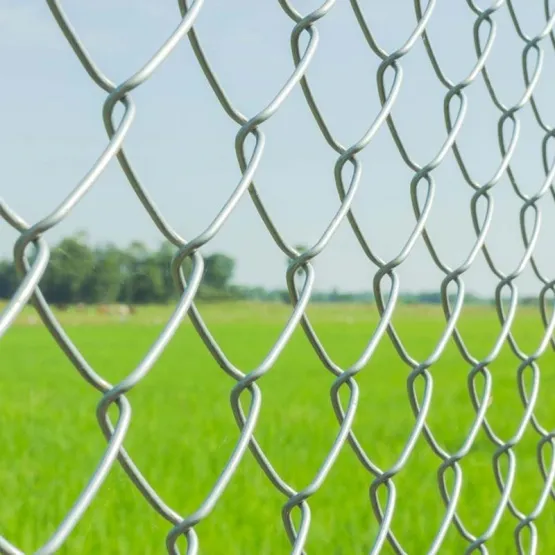
Mastering Site Security with Temporary Construction Chain Link Fence Systems
When we examine the architectural requirements of a secure perimeter, the temporary construction chain link fence stands out due to its transparency. Security is often a psychological game; being able to see through the mesh allows for natural surveillance from local law enforcement and passing pedestrians, which significantly deters trespassing and vandalism. This "open" design also minimizes wind resistance, a critical factor for sites located in coastal regions or high-altitude plains where solid hoarding might act like a sail and collapse during a storm.
Beyond the physical mesh, the integration of these fences into a site’s workflow is seamless. They act as a clear psychological and physical demarcation line. For contractors, this means a reduction in "casual" trespassing—the kind that leads to minor injuries and major lawsuits. By establishing a professional and sturdy boundary, the site sends a clear signal of organized management and strict safety compliance.
The Versatility and Mobility of Chain Link Temporary Fence Panels
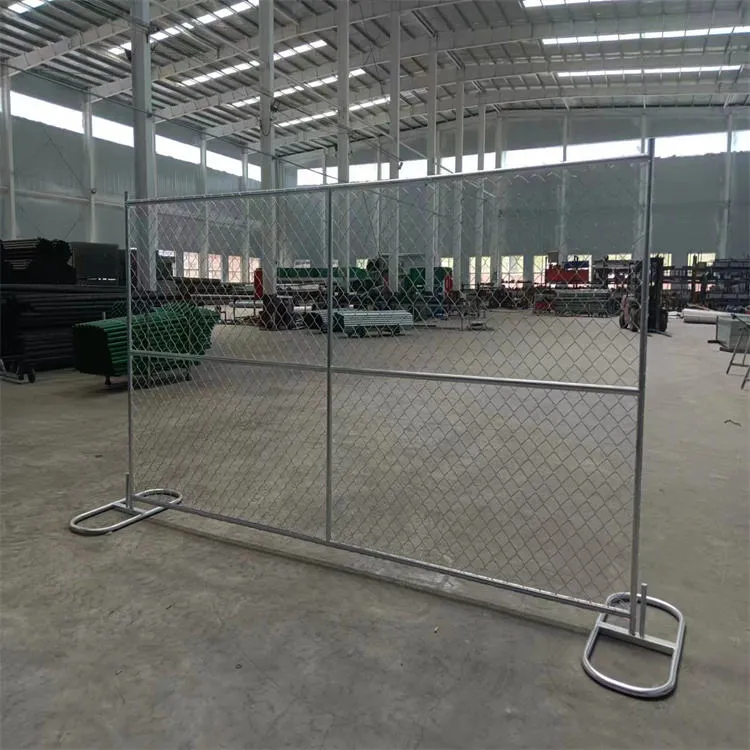
For projects that require rapid deployment and frequent relocation, chain link temporary fence panels offer an unparalleled advantage. These modular units are typically constructed from high-quality galvanized steel, ensuring they withstand the rigors of harsh weather and heavy machinery contact without succumbing to rust or structural failure. Because they are prefabricated in standard dimensions, they can be moved by a small crew without the need for specialized heavy lifting equipment.
The modularity of these panels allows for extreme customization. If a delivery gate needs to be moved fifty feet to the left to accommodate a new crane position, the panels can be unbolted and reconfigured in a matter of hours. This flexibility is essential in modern construction, where "just-in-time" logistics mean that access points must be fluid. Furthermore, because these panels are freestanding and do not require post-hole digging, they protect the integrity of the existing pavement or underground utilities, making them the preferred choice for renovation projects in sensitive historical districts or active commercial zones.
Stability and Surface Protection via the Temporary Chain Link Fence Base
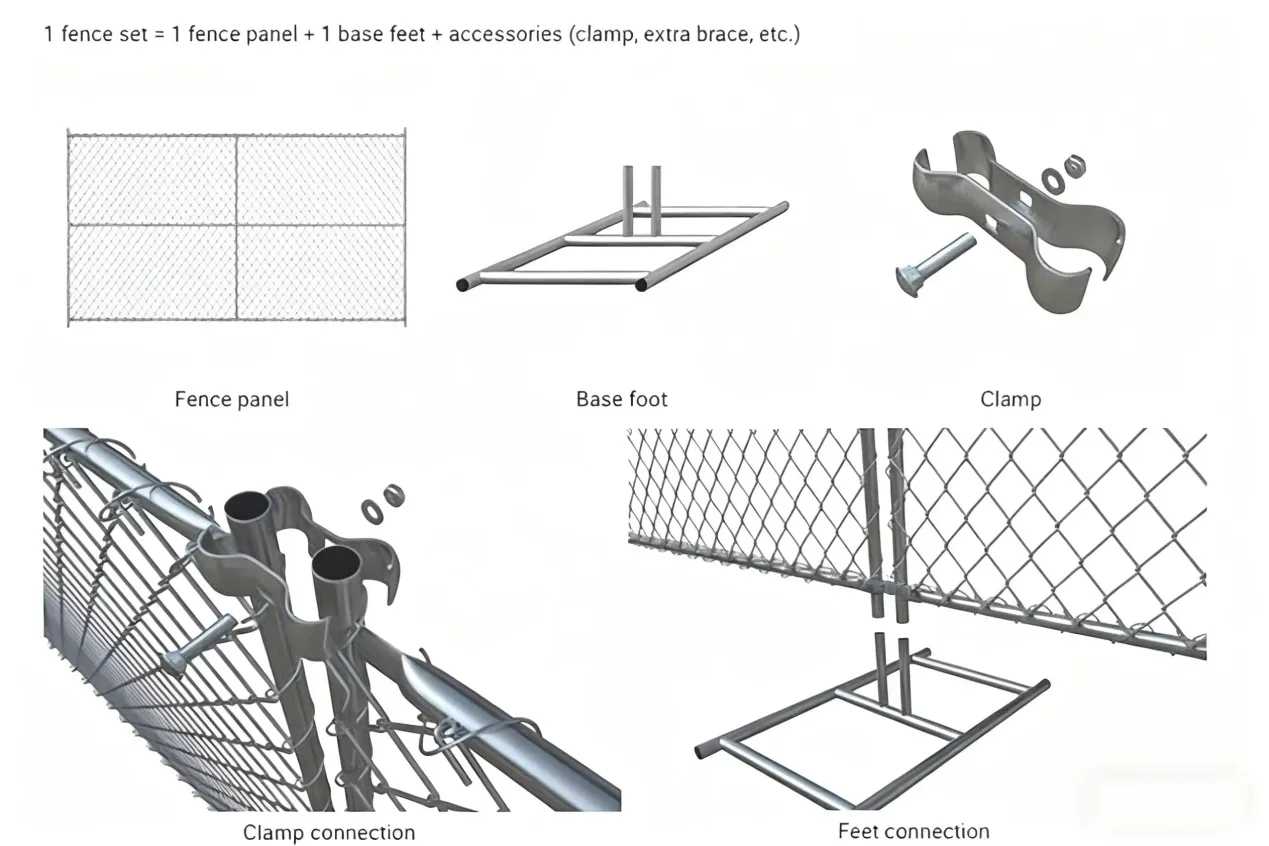
A common challenge on construction sites is securing a fence on surfaces where driving posts into the ground is impossible, such as concrete parking lots, finished asphalt, or bridge decks. This is where the temporary chain link fence base becomes the unsung hero of site safety. These weighted foundations—often made of heavy-duty steel or high-density recycled plastics—provide the necessary ballast to keep the fence upright under pressure.
The design of a high-quality base is focused on both stability and trip-hazard mitigation. Low-profile bases are increasingly popular in high-traffic pedestrian areas, as they minimize the footprint of the fence while maintaining a low center of gravity. For areas prone to high winds or where heavy privacy screening is attached to the mesh, these bases can be further secured with sandbags or bolted directly into the surface. This ensures that the perimeter remains unyielding, protecting the public from the heavy machinery and hazardous materials contained within the site.
Analyzing the Critical Temporary Chain Link Fence Detail for Longevity
To truly understand why some fencing solutions fail while others endure years of service, one must look closely at the temporary chain link fence detail. The quality of the construction is found in the "small" things: the gauge of the wire, the diameter of the frame tubing, and the integrity of the welds. A well-constructed panel features tension bars and bands that keep the fabric taut, preventing sagging that can occur after months of use.
Furthermore, the hardware used to connect the panels—the clamps and nuts—must be tamper-resistant to prevent unauthorized removal. The galvanization process is another vital detail; a hot-dipped galvanized finish provides a protective zinc coating that prevents oxidation. In coastal environments where salt air is a constant threat, or in industrial zones with corrosive runoff, these structural details are the difference between a fence that lasts the duration of a three-year project and one that requires constant, costly repairs. Even the "knuckled" or "twisted" edges of the mesh at the top and bottom of the fence are intentional details designed to prevent snagging and enhance security.
Environmental and Economic Benefits of Reusable Fencing
In an era where sustainability is becoming a requirement for government and private contracts alike, the reusability of chain link systems is a major selling point. Unlike timber hoarding, which often ends up in a landfill once a project is completed, steel fence components are nearly infinitely recyclable. Most rental companies or large-scale contractors maintain a fleet of panels that move from one site to the next for years.
This circular economy approach significantly lowers the carbon footprint of a construction project. Additionally, the ease of maintenance means that if a single panel is damaged by a vehicle, only that specific unit needs to be replaced, rather than an entire section of the perimeter. This cost-effectiveness, combined with the material's longevity, ensures that project budgets are optimized for the actual build rather than being drained by disposable perimeter solutions.
-
Hop Dipped Galvanized/PVC Coated Temporary Fence-Durable, Versatile, Reliable|Anping County Xingzhi Metal Wiremesh Products Co., Ltd
ȘtiriApr.14,2026
-
Hop Dipped Galvanized/PVC Coated Temporary Fence-Durable, Versatile, Reliable|Anping County Xingzhi Metal Wiremesh Products Co., Ltd
ȘtiriApr.14,2026
-
Hop Dipped Galvanized/PVC Coated Temporary Fence-Durable, Versatile, Reliable|Anping County Xingzhi Metal Wiremesh Products Co., Ltd
ȘtiriApr.14,2026
-
China PVC Coated Gabion Basket A Comprehensive Guide to Sourcing and Applications
ȘtiriFeb.24,2026
-
China Gabion Wall Solutions for Construction and Erosion Control
ȘtiriFeb.23,2026
-
Comprehensive Guide to China Gabion Bags Applications and Benefits
ȘtiriFeb.22,2026